In the rural zone of Cartagena del Chaira (Caqueta), 5 children and one young adult aged around 18 were found deep in the jungle after hiding from armed guerrilla groups for three days. FARC dissidents had kidnapped their parents.
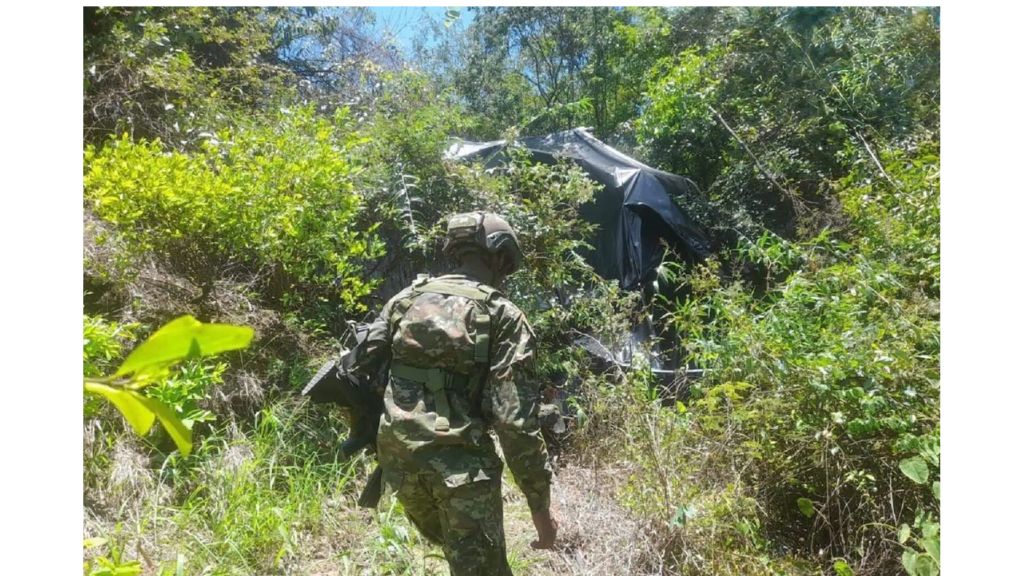
The full story, however, is even more harrowing than it first appeared. The children’s parents had refused to hand their children over to the Estado Mayor de Bloques y Frentes (EMBF), a dissident armed group operating in the Caquetá region. Buying their children precious time to reach the forest alongside their older sibling, the parents were subsequently kidnapped by the group and held for eleven days. After managing to escape, the couple reached an army checkpoint and reported both their ordeal and the location of their children. Colombian special forces launched a search operation deep in the jungle, eventually locating the six young people among dense vegetation. Once located, they were airlifted to a nearby hospital for medical attention.
This story cast a renewed spotlight on the country’s deepening forced recruitment crisis, one that now extends well beyond the abduction of children to include the forced conscription of adults like the children’s father, men and women compelled to join or remain in the ranks of illegal armed groups and subjected to forced labour.
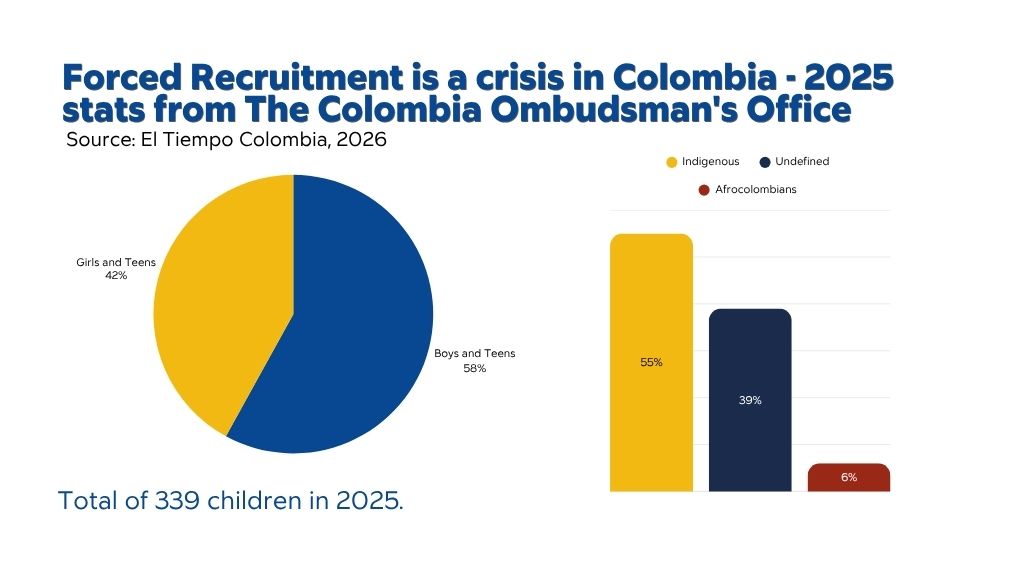
The scale of child recruitment alone is staggering. According to figures from Colombia’s Defensoría del Pueblo (the non-partisan national human rights ombudsman), 339 cases of forced recruitment of minors were documented in their system last year. The scale of child recruitment alone is staggering. Of those victims, 58% were boys and male adolescents while 42% were girls. Disturbingly, the majority of cases involving female victims also included signs of sexual exploitation. Moreover, these numbers almost certainly underrepresent reality since the control exerted by armed groups over affected communities forces silence upon victims and their families alike.
The ethnic dimension of the crisis is equally alarming. According to the data provided by the Defensoría del Pueblo, it is estimated that some 55% of documented cases involve indigenous communities, and 6% affect Afro-Colombian populations. When measured against their share of the total population, these figures reveal a deeply disproportionate burden falling on groups that have been marginalised by Colombian society.
Geographically, the department of Cauca leads the country with 157 documented cases, followed by Antioquia with 29 and Chocó with 25, based on the Defensoría’s recent estimates. This spread across at least nine departments confirms that recruitment is not driven by a single conflict, but by multiple overlapping territorial disputes. The groups responsible are equally varied: the Estado Mayor Central, the dissident faction known as ‘Mordisco’s’, accounts for nearly 42% of reported cases nationally, followed by unidentified groups, other FARC dissident factions, and the ELN.
The timing of the Caquetá rescue is particularly significant. In the same week, videos circulated on social media showing members of the Estado Mayor Central (EMC) in classrooms and on sports fields in Cauca, distributing school supplies alongside propaganda leaflets. This is a well-documented recruitment strategy that blurs the line between community engagement and indoctrination. The El Naya region, where some of those images originated, is considered a known epicentre of EMC recruitment activity, with the group accounting for nearly half of all child recruitment cases recorded last year.
What makes this moment notable is not the incidents themselves, as Colombia has lived with this reality for decades, but the accumulating weight of evidence that the crisis is intensifying.
Yet amid this grim landscape, there are those who are diligently holding the line. On the ground, Children Change Colombia (CCC), in partnership with organisations such as CRAN, Fútbol Pazífico, the German cooperation GIZ and TikTok, is working to address the conditions that make forced recruitment possible in the first place.
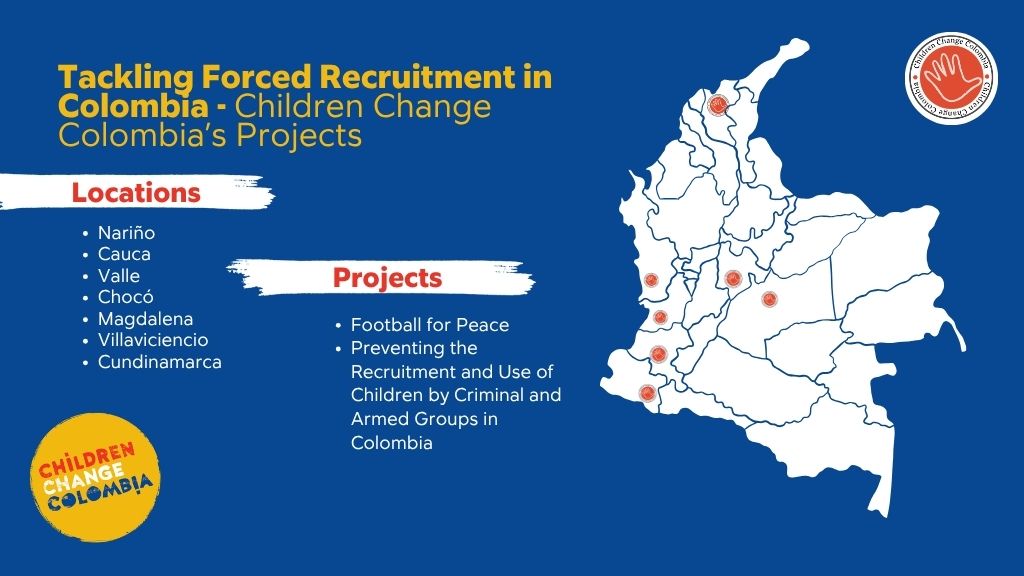
At CCC, we support these prevention efforts through community-based initiatives, including a multidimensional project that aims to reach more than a million children across several high-risk regions in the next 3 years. Football for Peace, a CCC project that prevents the forced recruitment of children in rural areas, is starting its 5th phase this year, and has already reached the departments of Choco, Cauca, Valle and Nariño.
These initiatives provide psychosocial support, digital literacy training, and livelihood opportunities to impacted communities. Furthermore, reintegration initiatives use sport and mental health support to strengthen resilience and social cohesion in communities vulnerable to forced recruitment. These efforts offer young people something harder to recruit away from: a sense of belonging and a future.
Written by: Diego Mojica | CCC Programmes and Communications Intern
Bibliography:
- Quevedo Delgado, Sara Valentina. “Rescate de Niños En Caquetá Expuso, de Nuevo, El Drama Del Reclutamiento: 15 Casos Entre Enero y Febrero y 339 En 2025.” El Tiempo (Colombia), March 31, 2026. https://www.eltiempo.com/justicia/paz-y-derechos-humanos/rescate-de-ninos-en-caqueta-expuso-de-nuevo-el-drama-del-reclutamiento-15-casos-entre-enero-y-febrero-y-339-en-3544385.
- Agudelo, Francy. “Se conocieron primeras imágenes de los cinco menores rescatados en la selva del Caquetá” InfoBae (Colombia). March 31, 2026. https://www.infobae.com/colombia/2026/03/31/se-conocieron-primeras-imagenes-de-los-cinco-menores-rescatados-en-la-selva-del-caqueta/
- Freixes, Josep. ” Children Rescued After Hiding from FARC Dissidents in the Colombian Jungle” Colombia One. March 31, 2026. https://colombiaone.com/2026/03/31/children-rescued-after-hiding-from-farc-dissidents-in-the-colombian-jungle/