Written by: Juan Pablo Manjarrés Varón
Imagine this: You're eight years old. They dress you in a two-piece swimsuit, style your hair like an adult's, and put you on a platform in front of thousands of people.
Across the river, people are drinking beer and applauding. Nobody asked you if you wanted to be there like that. It just… happened. And for twenty years, nobody thought anything of it.
This happened in Barbosa, Santander, at a contest that people ended up calling “Miss Tanguita.” It’s not an urban legend or social media hype: it’s a fact that now appears in judicial investigations, reports from the Colombian Institute of Family Welfare (ICBF), and files from the Attorney General’s Office. And it’s the perfect starting point to talk about something that affects us all—girls, boys, teenagers, parents, judges, and even those who design the apps you use every day: the hypersexualization of children.
Let’s calmly break down this issue. Without overly complicated language, but without diminishing the importance of what truly matters.
What does it mean to “hypersexualize” a child?
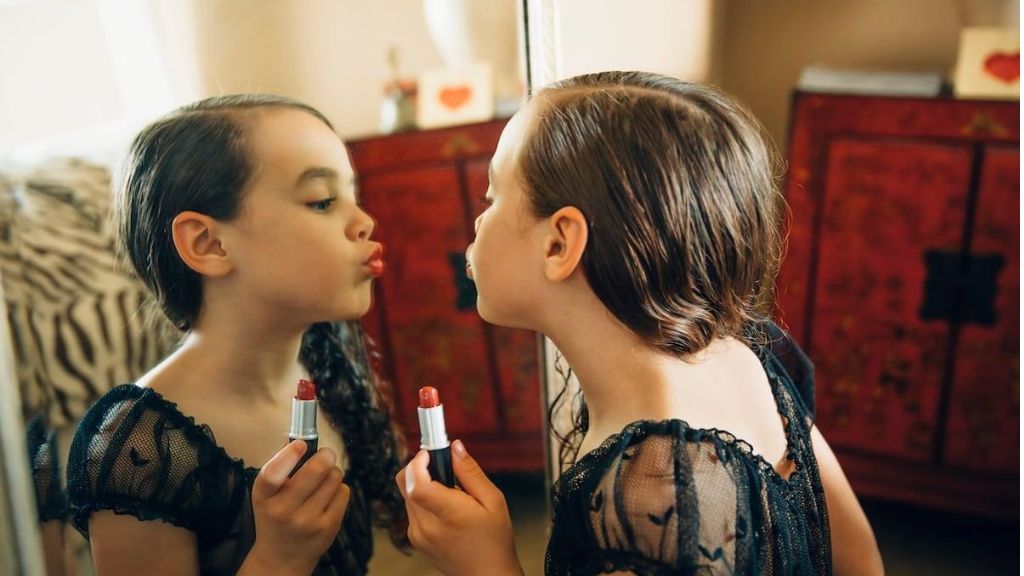
It’s not as strange a concept as it might sound. It’s very straightforward: it happens when a minor is required, taught, or rewarded to behave, dress, or pose like an adult, with an emphasis on their physical appearance or gestures that mimic adult seduction. Makeup, runway poses, clothing designed to accentuate the body, beauty filters that alter your face to make you look “older”… all of this, when applied to childhood, has a technical name, but it also has a very real and decidedly untechnical consequence: it robs a child of their right to be a child.
In Colombia, this right isn’t a favor adults do for you. It’s written in the law. The Code for Children and Adolescents establishes that children and adolescents have the right to privacy, dignity, and protection from all forms of exploitation. When this is violated, it’s not “an innocent cultural tradition”: it’s a failure on the part of the State.
The case that changed the rules: Miss Tanguita
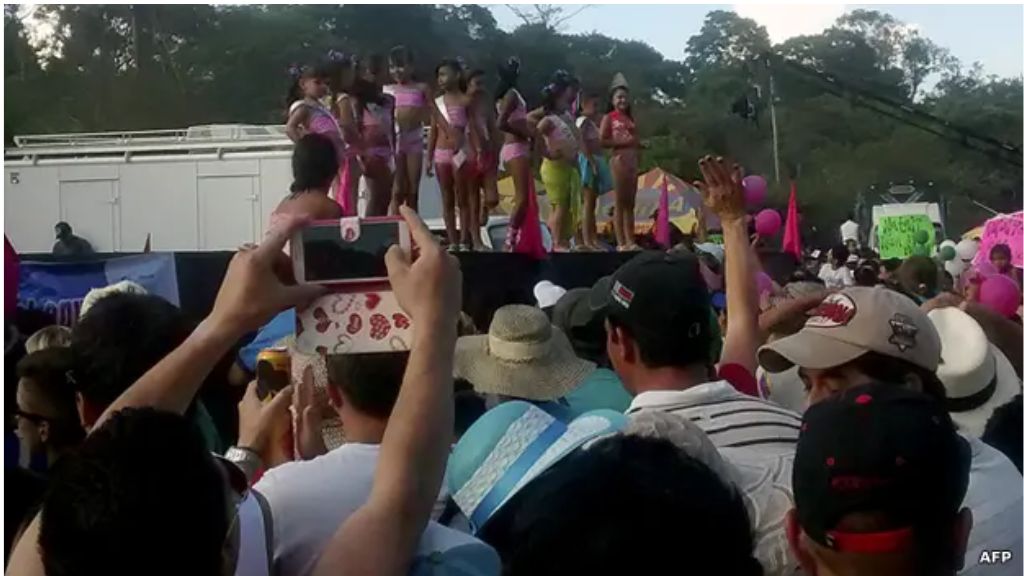
Let’s return to Barbosa, the city I mentioned at the beginning. In January 2015, during the Suárez River Festival, 32 girls between the ages of 5 and 11 paraded in two-piece swimsuits before a crowd of around 150,000 people. The event had been repeated for over two decades, that is, 20 years, without anyone publicly questioning it.
When the images were released, the institutional reaction was swift and decisive. The Colombian Family Welfare Institute (ICBF) condemned the incident as abhorrent and opened an administrative process to review the situation of the minors involved. The Attorney General’s Office launched a criminal investigation to determine if any crimes related to exploitation had been committed. And the Office of the Inspector General investigated the municipal administration for allocating public funds to an event that exposed the bodies of young girls.
The official defense at the time was that the activity promoted “sport and physical fitness” and that participation had been voluntary. But here lies the most important legal and human lesson of the entire case: the consent of an adult—even a parent—cannot authorize the violation of a child’s fundamental rights. Parental authority is not ownership; it is responsibility.
Today, “Miss Tanguita” is permanently banned. And it left something more valuable than its cancellation: it set a precedent that no city hall or state government can ever again fund an event that exposes children’s bodies in that way. That is the power of calling things by their name: when society decides to confront a problem head-on, laws begin to change.
The figures that almost no one has told you about
This is where the issue ceases to be a distant anecdote and becomes a reality that hits hard every day, all over the country.
In its first experimental survey on the commercial sexual exploitation of children and adolescents, DANE (Colombia’s National Administrative Department of Statistics) documented 22,697 minor victims linked to these crimes, with a national rate of 14.6 cases per 100,000 minors. Similarly, social organizations estimate that, on average, at least five children or adolescents are victims of sexual exploitation every day in Colombia.
For its part, the National Institute of Legal Medicine records a historical average of more than 20,000 medicolegal examinations annually for alleged sexual offenses against minors – about 57 cases per day – and 87% of those victims are girls, with the highest concentration between the ages of 12 and 17.
However, according to the ICBF, 81% of the cases opened to restore rights violated by violence involve girls and adolescent women. And one statistic that should particularly concern us in the digital age: the study Disrupting Harm found that one in five adolescents in Colombia suffered some form of abuse or sexual exploitation facilitated by the internet within a single year.
Bogotá and its metropolitan area account for the largest proportion of reported cases, followed by the coffee-growing region, Antioquia, and Valle del Cauca. But there is a warning that is rarely discussed: in departments like La Guajira, Chocó, Amazonas, Arauca, and Casanare, the official figures appear surprisingly low. Public policy experts warn that this does not mean the problem is less severe there; it means there is a statistical silence, fueled by the lack of Family Courts, language barriers in indigenous communities, and the control that armed groups exert over these territories, which prevents complaints from even being filed.
The catwalk no longer needs a platform: it has arrived on the cell phone
This is the part we should discuss most in 2026, because it no longer depends on a municipal festival: it depends on a phone.
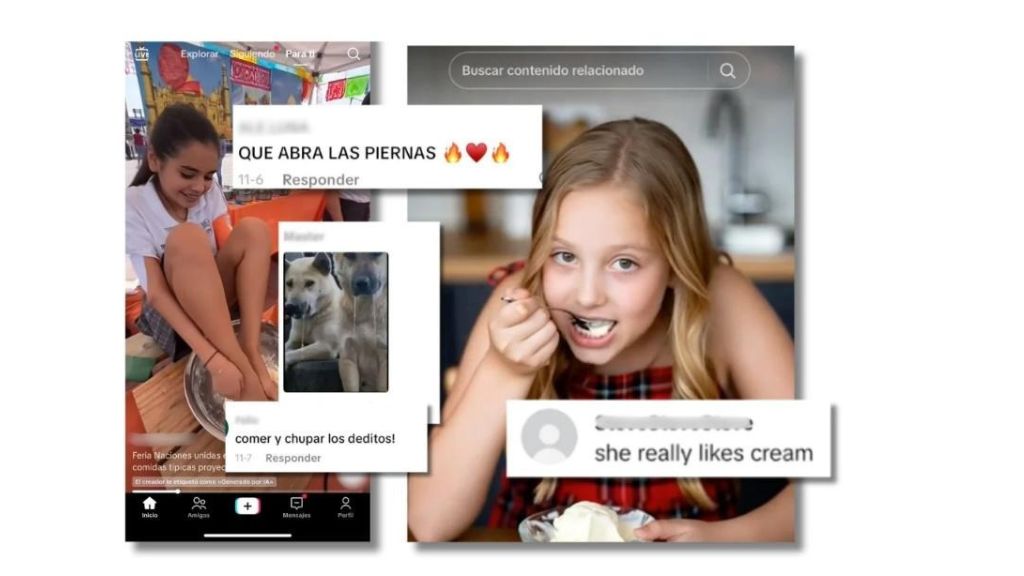
Social media is not neutral. Its algorithms are designed to reward content that generates more interaction, and studies on digital behavior show that content emphasizing the body or “adult” poses tends to gain more visibility. When a girl or teenager interacts with this type of content, the system shows her more of the same, building a distorted idea of what is “normal.” Added to this are artificial intelligence filters that alter faces in real time, teaching a developing person that their real body needs to be “corrected” to be accepted.
The legal problem is that Law 1098 of 2006 – the Children and Adolescents Code – was designed for a world with physical borders. In the digital environment, those borders dissolve: platforms respond to international regulations and their own terms of service, making it difficult for the ICBF (Colombian Institute of Family Welfare) or the Prosecutor’s Office to act as quickly as they would in a face-to-face event. Added to this is a phenomenon that already has a name in the specialized literature: thesharingThat is, the exposure of children’s images on social media by their own parents, often without considering the risk.
The psychological result also has a name: self-objectification. It is the process by which a girl begins to see herself as an external observer would, and her value ceases to be linked to what she can do—play, create, learn—and instead depends on how “attractive” she is. This is directly related to an increase in eating disorders, anxiety, and a forced social maturation that is not accompanied by the emotional maturity necessary to sustain it.
What the law says - and what it fails to say
For those reading this in a judge’s robe or with the Constitution under their arm: the framework exists and is robust. Law 1098 of 2006 (Children and Adolescents Code), Law 1620 of 2013 on school coexistence, and Decree 1965 that regulates it, along with the Constitutional Court’s jurisprudence on the best interests of the child, provide sufficient tools to act against physical exploitation. The Miss Tanguita precedent demonstrates that, when there is institutional will, the system responds.
The real gap lies in the speed of adaptation to the digital environment. While a mayor can be disciplined for funding a stage, there is still no equally agile mechanism to address an algorithm that exposes millions of girls simultaneously, without requiring public funding or municipal permission. That is, perhaps, the next major legislative debate that Colombia must address.
So, what do we do with all this?
If you are under 18 and have read this far: your body is not a spectacle, it is not merchandise, and it doesn’t need anyone’s approval to have value. If you ever feel pressure—from an adult, a platform, a contest—to look or behave in a way that makes you uncomfortable, you have the right to say no, and you have the right to tell a trusted adult. If you don’t know who to turn to, the ICBF’s Line 141 is available 24/7, nationwide.
If you’re a lawyer, teacher, parent, or any other professional, the challenge is no longer just monitoring stages. It’s understanding that protecting children today also involves what happens behind a screen, and that the law—like any evolving tool—must continue to evolve to meet this reality.
Miss Tanguita taught us that a society can change its mind when it decides to confront what it once normalized. The question that remains is whether we are willing to look with the same honesty at what is happening right now, on every cell phone, in every home.