Written by: Stephany de Cohen
The PISA 2025 results were published on September 8th, showing a continued decline in educational performance across many countries.
More than 760,000 students participated in the assessment across 91 countries, representing 33 million 15-year-olds worldwide. Across OECD countries, average performance reached its lowest levels ever observed in science, reading and mathematics (OECD, 2026). Reading scores saw particularly steep declines. This included skills such as evaluating information, making connections across multiple sources and thinking critically about what we read, skills that are becoming increasingly important in the age of AI. Instances of “hasty reading” where students read quickly but inaccurately almost doubles between 2018 and 2025 (OECD, 2026). The results clearly raise concerns about how well education systems are preparing young people. At the same time, looking beyond the overall averages shows that educational performance is not distributed equally. This makes PISA particularly interesting not only as a measure of what students know, but also as a way of looking at inequalities in children’s opportunities to learn.
What is PISA?
PISA is a regularly conducted assessment of 15-year-old students that looks at the extent to which they have acquired the knowledge and skills needed to participate fully in social and economic life. Rather than only assessing whether students can reproduce what they have learned, PISA looks at how well they can apply their knowledge, both in and outside school, to real-life problems. In 2025, 91 countries participated, including Colombia, Chile, Costa Rica, Mexico, Argentina, Brazil and Paraguay (OECD, 2026). With such a large number of countries and students participating, PISA gives us an important picture of how young people are performing across different education systems. And while the 2025 results show a clear drop in performance, understanding what may be driving these changes is less straightforward.
Understanding the decline
There is no single explanation for the decline in performance. The students who participated in PISA 2025 were around 10 or 11 years old when the COVID-19 pandemic began, meaning that school closures took place during an important period in their education. The disruption also went beyond time spent outside the classroom, as students had very different experiences of remote learning and different levels of access to digital resources and support from their school, teachers and families (OECD, 2026). The OECD also points to increased student absenteeism following the pandemic as one possible lasting disruption to learning (OECD, 2026). However, the OECD (2026) found no simple relationship between the length of the school closures and later school performance. While the pandemic thus remains part of the wider context in which this generation learned, it cannot on its own explain the continued decline in performance.
Beyond the pandemic, OECD (2026) also looks at broader changes in young people’s digital lives and reading habits. Between 2022 and 2025, the proportion of students spending more than one hour a day browsing social networks increased. At the same time, the way young people engage with written information has also been changing. Students increasingly encounter text through digital environments, while reading for enjoyment has declined. The OECD points to research suggesting digital reading can involve shorter and more fragmented engagements with texts and more frequent switching between tasks (OECD, 2026). These findings do not establish that social media or changing digital habits are causing the decline in reading performance. However, they do raise questions about whether changes in how young people engage with written information may be part of the wider context in which reading skills are developing.
While there may be no single explanation for these changes in performance, looking beyond the overall results also show that not all students are affected equally.
Inequality in performance
Across OECD countries, students from more advantaged socioeconomic backgrounds performed better on average than students from disadvantaged backgrounds (OECD, 2026). This means that behind the overall decline in performance, there are important differences in who is struggling the most. The relationship between socioeconomic background and school performance is well established. A large-scale meta analysis by Liu et al. (2022), covering more than five million students across 105 countries and areas, found a consistent relationship between socioeconomic status and academic achievement. Interestingly, the study also found that increasing access to education did not necessarily reduce inequalities in academic outcomes between students from higher and lower socioeconomic backgrounds. Of course, socioeconomic background does not determine how well an individual child will perform. However, children do not enter education under the same circumstances. The resources available at home, the schools they attend and the wider environments in which they grow up can all shape the opportunities they have to learn. Increasing access to education is therefore important, but it does not automatically mean that children have equal opportunities within education. This relationship between access, inequality and performance becomes particularly interesting when looking at Colombia.
A stable, but complicated picture
Colombia’s results in 2025 remained relatively stable compared with 2022. Science performance has also remained stable over a longer period, since 2015. Mathematics and reading tell a different story, with results significantly below those observed in 2018 (OECD, 2026). However, there is an important development between these numbers. Between 2018 and 2025, the number of Colombian 15-year-olds eligible to participate increased, despite the overall population of 15-year-olds decreasing. According to the OECD (2026), this suggests that secondary school enrollment increased steadily during this period. This matters when interpreting the decline. The OECD (2026) links part of the lower mathematics and reading results to the inclusion of more 15-year-olds from previously marginalised populations. Results among the more advantaged students whose situation was unaffected by the expansion did not decline (OECD, 2026).

Colombia therefore shows that educational performance and educational access do not necessarily move in the same direction at the same time. Expanding access to secondary education is progress in itself, even when this is not immediately reflected in higher average test scores. At the same time, access to school does not automatically mean equal opportunities to learn. Research by Rodriguez-Gomez et al. (2024) on Colombia’s rural-urban achievement gap found that differences in school characteristics play an important role in explaining differences in educational performance. Where a child goes to school and the conditions they encounter there matter too. However, while access to secondary education in Colombia has expanded, a considerable number of children remain outside the education system altogether.
Unequal access
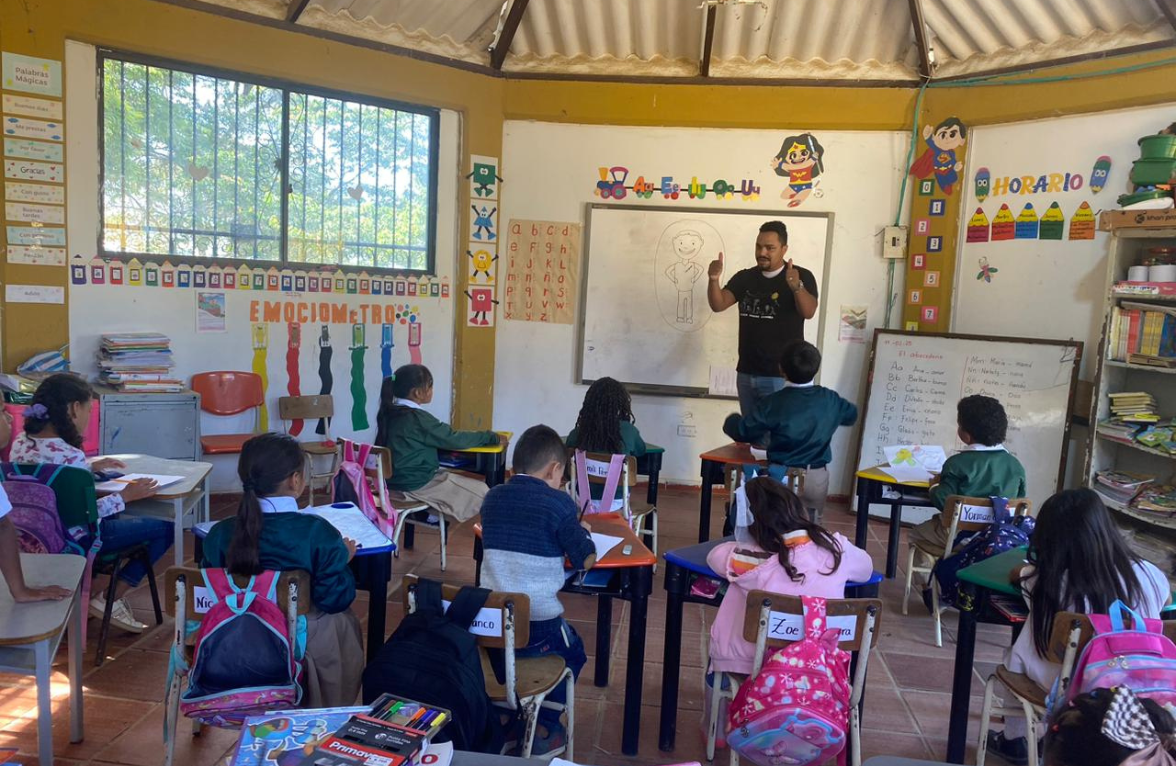
Despite the expansion of secondary education in Colombia, access remains a challenge. More than 900,000 children and adolescents are currently outside the education system (UNICEF, 2025). This is important alongside the PISA results. While more previously marginalized 15-year-olds are now entering secondary education and becoming represented in assessments such as PISA, a considerable number of children are still not accessing education at all. Structural challenges continue to create barriers to accessing and remaining in education. Some of the children CCC works with live in communities where access to education is affected by poverty, geographical isolation, conflict and limited resources. Its education programs work with children, schools and communities to address some of these barriers. However, these programs also show that access is about more than getting a child through the school gates. Children need to be able to remain in education and have the conditions and support necessary to learn.
The PISA 2025 results therefore tell an important story about educational performance. Colombia adds another layer to that story. More children accessing secondary education is an important achievement, but the inequalities in performance show that access alone is not enough. The challenge is not only to ensure that children are in school, but that all children have a meaningful opportunity to learn once they are there.
References:
- Liu, J., Peng, P., Zhao, B. and Luo, L. (2022) Socioeconomic status and academic achievement in primary and secondary education: A meta-analytic review. Educational Psychology Review, 34, pp. 2867–2896. https://doi.org/10.1007/s10648-022-09689-y
- OECD (2026), PISA 2025 Results (Volume I): Future-Ready Students, PISA, OECD Publishing, Paris, https://doi.org/10.1787/73451bc5-en
- Rodríguez-Gómez, D., Rodríguez Gómez, J. S. and Gomez-Gonzalez, J. E. (2024) The rural-urban student performance gap in Colombia. Desarrollo y Sociedad, 97. DOI: 10.13043/DYS.97.3
- UNICEF Colombia (2025) Recortes podrían dejar sin estudio a seis millones de niñas, niños y adolescentes en América Latina y el Caribe. Available at: UNICEF Colombia [Accessed 20 September 2026]